All about Planet LHS1140b
Full information guide research 2026
Info on planet LHS 1140b
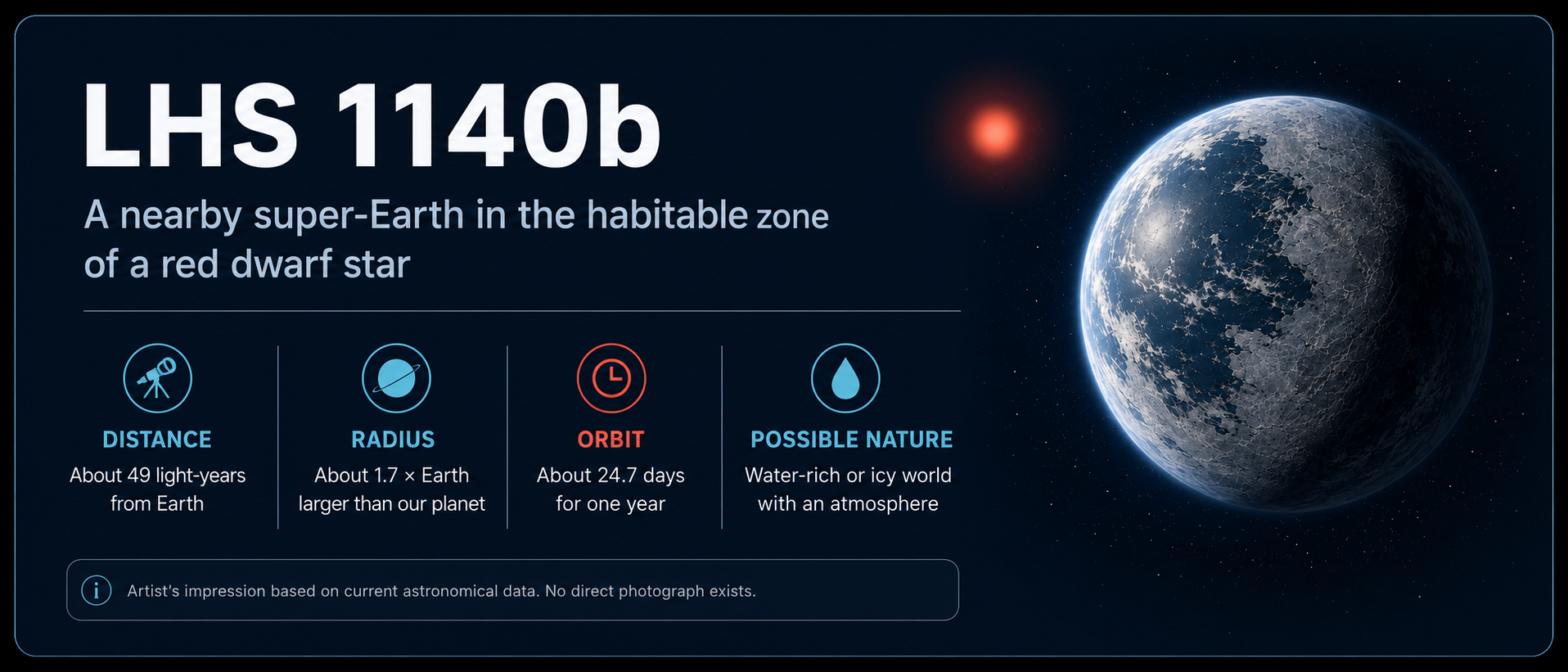
LHS 1140b has become one of the most exciting planets discovered beyond our Solar System. Located about 49 light-years from Earth, this distant world is a rocky “super-Earth” orbiting a small red dwarf star in the constellation Cetus. It is larger and more massive than Earth, but lies within its star’s habitable zone, where temperatures may allow liquid water to exist.
Interest in the planet increased sharply in July 2026 after scientists reported evidence of an atmosphere surrounding it. The finding, covered in this BBC News report on LHS 1140b, is a major development in the search for habitable planets and life beyond Earth.
What is LHS 1140b?
LHS 1140b is an exoplanet, meaning a planet outside our Solar System. It was discovered in 2017 using the transit method. Astronomers observed the slight dimming of its host star as the planet passed between the star and Earth.
According to NASA’s LHS 1140b profile, its radius is approximately 1.7 times that of Earth and one orbit takes about 24.7 days. Its mass is estimated at roughly 5.6 times Earth’s mass, although measurements may be refined through future observations.
The planet orbits much closer to its star than Earth does to the Sun. Its host, however, is a cool, low-mass M-type red dwarf. Because this star produces less energy than the Sun, LHS 1140b can orbit nearby while receiving an amount of heat compatible with the possible presence of liquid water.
Has an atmosphere been found on LHS 1140b?
The most important recent discovery is the detection of helium escaping from LHS 1140b. Researchers studied the planet as it crossed its star and found a helium absorption signal in observations made in 2024. An observation in 2025 did not show the same signal, suggesting that atmospheric escape may vary over time.
The study, Helium escaping from the atmosphere of a nearby rocky exoplanet orbiting in a habitable zone, describes an upper atmosphere dominated by helium and depleted in hydrogen. Heavier gases may remain trapped at lower altitudes.
The result does not reveal the atmosphere’s complete composition, but it provides compelling evidence that LHS 1140b has retained a gaseous envelope. That is significant because rocky planets around red dwarfs can be exposed to radiation capable of stripping their atmospheres away.
The finding has been reported as the first direct atmospheric detection for a rocky exoplanet within another star’s habitable zone. It gives astronomers a realistic target for testing whether a super-Earth can maintain the conditions required for water and, potentially, life.
Could LHS 1140b be an ocean planet?
LHS 1140b may be very different from Earth. Studies of its radius, mass and density suggest it could contain far more water than our planet. Models estimate that water might represent around 9 to 19 per cent of its total mass. Earth has only a tiny fraction of its mass in surface water.
James Webb Space Telescope observations have helped researchers reject the idea that LHS 1140b is simply a small Neptune-like planet inside a thick hydrogen atmosphere. A 2024 study, Transmission Spectroscopy of the Habitable Zone Exoplanet LHS 1140b with JWST/NIRISS, found that hydrogen-rich models did not fit the data. It instead identified tentative evidence consistent with a heavier, possibly nitrogen-rich atmosphere.
Another paper, LHS 1140b is a potentially habitable water world, concluded that an ocean-rich planet with a substantial atmosphere remained the most plausible explanation for its low density.
Scientists have suggested that LHS 1140b could be a frozen “snowball” planet with liquid water beneath an icy shell. Another possibility is an “eyeball planet”. Because it may be tidally locked, one side could always face its star. A circular area of open ocean might exist on the warmer, star-facing side, surrounded by ice across the remainder of the planet.
The University of Montréal’s Institute for Research on Exoplanets provides more information about the scientific models suggesting that LHS 1140b could be an ice-rich or ocean-bearing world.
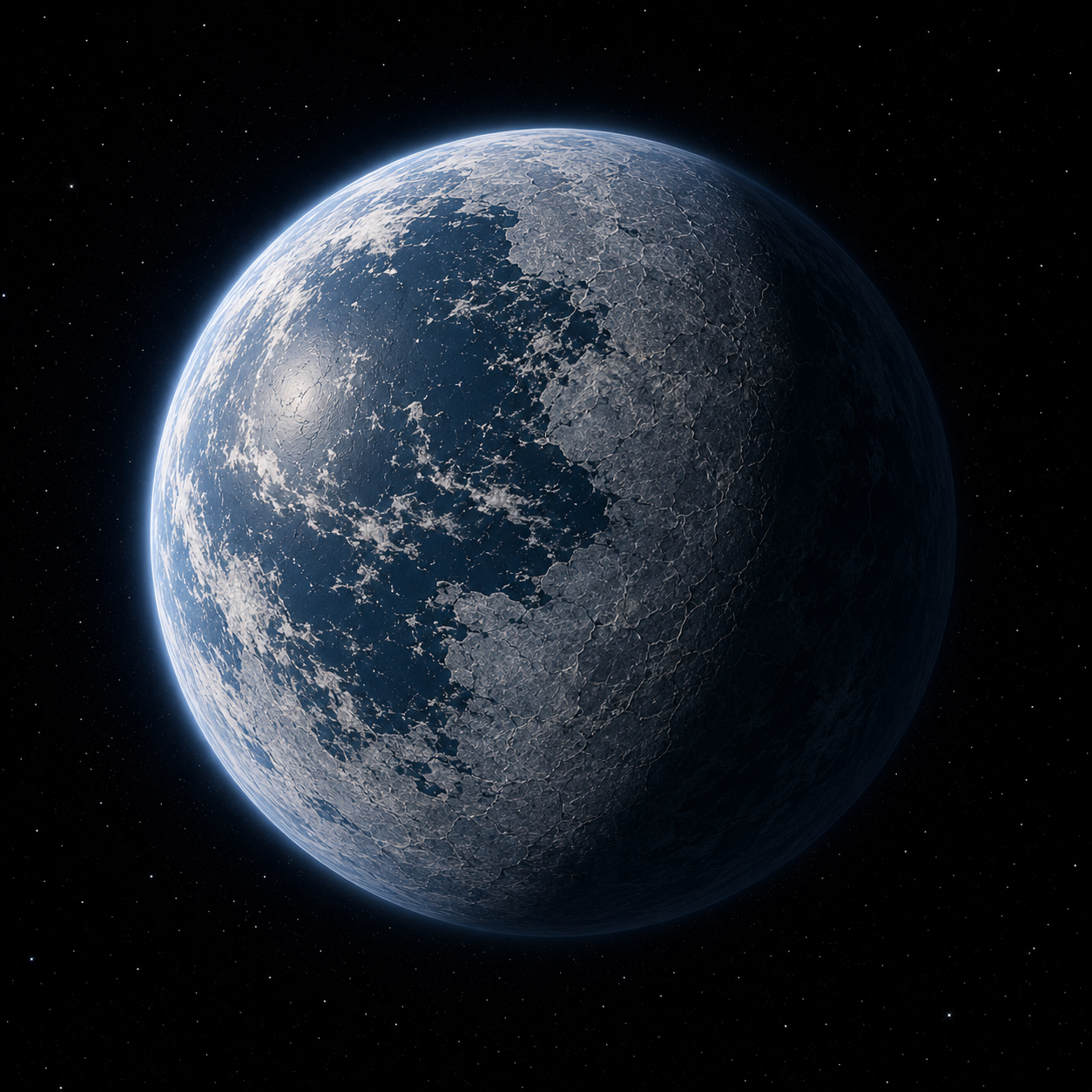
These are scientific models, not confirmed pictures. No telescope has photographed oceans, ice or continents on LHS 1140b.
Is there life on LHS 1140b?
There is no evidence that life exists on LHS 1140b. Detecting an atmosphere does not prove the planet is inhabited, while being in a habitable zone does not automatically make a world habitable.
Life as we know it would probably require stable liquid water, suitable chemistry, tolerable radiation and a climate that remains favourable for long periods. Scientists do not yet know whether LHS 1140b meets these conditions.
Even so, the planet is an unusually promising target. It is relatively nearby in astronomical terms, passes in front of its star from our viewpoint and orbits a star calmer than many red dwarfs. Every transit allows instruments to examine starlight filtering through its atmosphere and search for gases such as carbon dioxide, water vapour, methane and oxygen.
The NASA Exoplanet Archive overview of the LHS 1140 system provides current measurements and links to the growing scientific literature.
Why LHS 1140b matters
LHS 1140b gives astronomy the opportunity to test several essential questions. Can a rocky world survive for billions of years near a red dwarf without losing its atmosphere? Can it retain water? Can observations distinguish between an icy planet, an ocean world and a dry super-Earth?
Future studies with the James Webb Space Telescope and powerful ground-based observatories should reveal more about the gases beneath the escaping helium. Researchers will also investigate the host star, possible climates and the neighbouring planet LHS 1140c, which appears not to have retained a comparable atmosphere.
For now, LHS 1140b is best described as a nearby, temperate super-Earth with strong evidence of an atmosphere and a scientifically plausible chance of containing water. It is not a second Earth, nor proof of extraterrestrial life. It is, however, one of the strongest places astronomers can examine for the conditions that make life possible.
Where is planet LHS 1140b
LHS 1140b is located approximately 48.9 light-years from Earth, in the direction of the constellation Cetus, traditionally known as the Sea Monster or the Whale.
It is not floating through space alone. LHS 1140b belongs to a small planetary system built around a cool red dwarf star called LHS 1140. The entire system sits within our own galaxy, the Milky Way, in what astronomers would consider the Sun’s wider stellar neighbourhood.
A light-year measures distance, not time. It is the distance light travels in one year, which is about 9.46 trillion kilometres. This places the LHS 1140 system roughly 462 trillion kilometres from Earth.
The light reaching our telescopes today began its journey almost 49 years ago. In other words, we do not see the star and its planets exactly as they are now. We see them as they appeared nearly half a century in the past.
Although travelling 48.9 light-years is far beyond the ability of present-day spacecraft, the system is considered relatively close in astronomical terms. The Milky Way is approximately 100,000 light-years across, so LHS 1140b is much more like a distant neighbour than a world on the far side of the galaxy.
Its position in the night sky
Astronomers use celestial coordinates to give every object in the sky a precise location. These work rather like longitude and latitude on Earth.
The approximate coordinates of the star LHS 1140 are:
Right ascension:
00 hours, 44 minutes, 59.67 seconds
Declination:
−15 degrees, 16 minutes, 26.79 seconds
Right ascension describes an object’s east-to-west position across the sky. Declination tells us how far north or south it appears in relation to the celestial equator.
A declination of around −15 degrees places LHS 1140 south of the celestial equator, although the surrounding area of sky can still be observed from much of both the Northern and Southern Hemispheres.
From Spain, the Canary Islands, southern Europe and much of the United States, the constellation Cetus can be seen during the right season. It is generally best placed in the evening sky during the northern autumn and early winter.
Cetus covers a large but relatively faint area of the sky near the constellations Pisces, Aquarius, Eridanus and Fornax. On wider sky charts, LHS 1140 appears in the same general region as better-known stars such as Tau Ceti and Deneb Kaitos, although LHS 1140 itself is much fainter.
It is worth remembering that constellations are patterns created by our viewpoint from Earth. Saying that LHS 1140b is “in Cetus” does not mean that all the stars in Cetus are close to one another in space. They may actually be separated by enormous distances. Cetus simply tells us which part of the sky to look towards.
The European Southern Observatory’s location chart for LHS 1140 shows where the star appears within Cetus. On the chart, LHS 1140 is marked with a red circle.
Can LHS 1140 be seen from planet Earth?
The host star LHS 1140 is extremely faint in visible light. It has an apparent visual magnitude of about 14.15, meaning it cannot be seen with the naked eye.
It is also too faint to be easily observed with ordinary binoculars or a small amateur telescope. According to the European Southern Observatory, the star is too faint to be viewed with a small telescope.
The planet LHS 1140b is far fainter still. It cannot be seen as a separate dot in an ordinary telescope image.
Astronomers discovered the planet indirectly using the transit method. As LHS 1140b moves around its star, it regularly passes between the star and Earth. During each transit, the planet blocks a tiny amount of the star’s light.
Its orbit happens to be aligned almost edge-on from our viewpoint, allowing sensitive instruments to detect these repeated dips in brightness.
LHS 1140b completes one full orbit every 24.7 Earth days. This gives astronomers regular opportunities to measure the planet and study the starlight passing through its atmosphere.
Where is LHS 1140b within its own system?
LHS 1140b orbits much closer to its star than Earth does to the Sun.
Its average orbital distance is approximately 0.095 astronomical units, or about one-tenth of the distance between Earth and the Sun. This means it travels roughly 14 million kilometres from its star.
Earth, by comparison, orbits the Sun at an average distance of almost 150 million kilometres.
At first, this may make LHS 1140b sound extremely hot. However, its host star is very different from our Sun. LHS 1140 is an M-type red dwarf, which is considerably smaller, cooler and less luminous.
Because the star produces much less energy than the Sun, LHS 1140b can orbit very close to it without necessarily becoming unbearably hot.
This position places the planet within its star’s habitable zone. This is the region where temperatures might allow liquid water to exist, provided the planet also has a suitable atmosphere and climate.
Being in the habitable zone does not prove that LHS 1140b contains water or supports life. It does, however, make it a particularly valuable planet for scientists to study.
NASA provides further measurements in its LHS 1140b exoplanet profile.
Are there other planets in the system?
LHS 1140b is not the only known planet orbiting the star.
A smaller inner planet called LHS 1140c travels around the same red dwarf. It completes an orbit in approximately 3.78 days, meaning it is positioned much closer to the star than LHS 1140b.
The letter “b” does not mean that LHS 1140b is the planet closest to its star. Exoplanets are normally given letters based on the order in which they are discovered.
LHS 1140b was the first confirmed planet found around the star, so it received the letter “b”. LHS 1140c was discovered later.
Current information about the system can be found in the NASA Exoplanet Archive overview of LHS 1140.
Why do some reports say it is 40 light-years away?
Some earlier reports describe LHS 1140b as being about 40 light-years from Earth.
This figure appeared in early coverage of the planet’s discovery in 2017. More recent measurements listed by the NASA Exoplanet Archive place the system at approximately 14.986 parsecs, which is equal to around 48.9 light-years.
The difference is largely the result of improved distance measurements, along with the broad rounding used in some earlier news reports.
The clearest modern description is:
LHS 1140b is a nearby exoplanet approximately 49 light-years from Earth. It orbits a cool red dwarf star in the direction of the constellation Cetus, within our own Milky Way galaxy.